
Crypto Staking Risks
 Admin
Admin- posted on
- No Comment
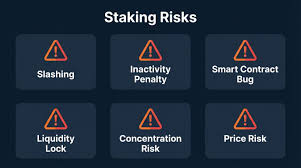
This guide aims to clear up some of those worries. We’ll walk through what staking really is, why people do it, and then dive deep into the things that could go wrong. We want you to feel confident and informed about your choices. Think of me as your guide, helping you navigate through the sometimes-confusing world of crypto staking. Let’s make sure you know what you’re getting into, so you can make smart decisions for your digital funds.
Crypto staking involves locking up your digital coins to help run a blockchain network. In return, you earn rewards. While it can be a way to grow your holdings, potential risks include impermanent loss, platform hacks, validator issues, and uncertain regulations. It’s crucial to understand these downsides before staking.
What Is Crypto Staking?
At its heart, crypto staking is a way to earn rewards by holding onto certain digital coins. Many newer blockchains use a system called “Proof-of-Stake” (PoS). This system needs people to “stake” their coins. Staking means you lock up a certain amount of your cryptocurrency. You do this to help validate transactions and secure the network. It’s like putting up a security deposit to prove you’re a good actor in the system.
When you stake, you are essentially giving the network your coins to use. The network uses these staked coins to perform tasks. These tasks help keep the blockchain running smoothly and safely. Think of it as lending your coins to the bank. The bank uses your money to make loans, and they pay you interest. Staking is similar but for a decentralized network.
The reason blockchains use staking is to avoid the high energy use of older systems like “Proof-of-Work” (PoW). PoW systems, like Bitcoin’s, require powerful computers to solve complex puzzles. This uses a lot of electricity. Proof-of-Stake is much more energy-efficient. It relies on the staked coins to achieve network consensus, which is how everyone on the network agrees on the state of the ledger.
Why Do People Stake Their Crypto?
The main draw for staking is earning rewards. These rewards are usually paid out in the same cryptocurrency that you staked. It’s a passive income stream. People like the idea of their digital assets working for them. They can grow their holdings without actively trading or selling. This can be very appealing, especially in a volatile market.
For instance, if you stake Ethereum (ETH) after its shift to Proof-of-Stake, you can earn a percentage of your staked amount each year. This percentage, often called the Annual Percentage Yield (APY), can be quite attractive. It’s a way to compound your holdings over time. Many see it as a long-term strategy for wealth building in the digital space.
Beyond just earning more coins, staking can also make you feel more involved in the blockchain community. By staking, you are contributing to the network’s security and stability. Some people feel a sense of ownership and participation. They are not just users; they are active stakeholders in the network’s success. This shared goal can be a strong motivator for many crypto enthusiasts.
The Risks of Staking: What Could Go Wrong?
Now, let’s talk about the flip side. Staking isn’t a guaranteed win. There are several significant crypto staking risks that can affect your investment. It’s crucial to be aware of these potential problems before you commit your funds. Think of it like getting insurance; you hope you never need it, but it’s wise to have it.
We’ll break down the main types of risks. This includes issues with the value of your coins, problems with the platforms you use, and even things outside your control, like market changes or new rules.
Key Staking Risks at a Glance
Market Volatility: The price of staked crypto can drop significantly.
Impermanent Loss: Especially in DeFi, this is a common issue.
Platform Hacks: Exchanges or staking pools can be targets for attackers.
Validator Slashing: If a validator makes mistakes, they can lose staked funds.
Lock-up Periods: Your coins might be inaccessible for a set time.
Regulatory Uncertainty: New laws could impact staking services.
1. Market Volatility: The Price Drop Risk
The most obvious risk with any cryptocurrency is its price. Digital assets are known for wild price swings. When you stake your coins, you are holding them for a period. During this time, the market value of your staked crypto could plummet.
Imagine you stake $1,000 worth of a coin. You earn a 5% reward over a year, which is $50. Sounds good, right? But if the price of that coin drops by 50% during the same year, your initial $1,000 is now worth only $500. The $50 you earned in rewards doesn’t make up for that huge loss. Your total investment has shrunk significantly.
This is a critical point. The rewards you earn are usually in the same coin. If that coin loses value, your rewards also become less valuable. It’s essential to consider the potential for price depreciation. This risk is higher for newer or more speculative cryptocurrencies.
When Prices Fall
Your Stake
Initial investment is locked.
Market Drops
Coin price decreases sharply.
Rewards Earned
More coins received, but worth less.
Overall Result
Total value often decreases.
2. Impermanent Loss: A DeFi Specific Concern
This is a term you’ll hear a lot in decentralized finance (DeFi). It’s particularly relevant if you are staking coins in liquidity pools, which is a common way to stake in DeFi. Impermanent loss happens when the price of the coins you’ve deposited into a liquidity pool changes compared to if you had just held them.
Let’s say you provide liquidity for a trading pair like ETH/USDC. You deposit $500 worth of ETH and $500 worth of USDC. If the price of ETH goes up significantly compared to USDC, the automated market maker (AMM) in the pool will adjust the ratio. It will sell some of your ETH and buy more USDC to rebalance. When you withdraw your funds, you might end up with less ETH and more USDC than you started with. The value of your withdrawn assets might be less than if you had simply held both ETH and USDC separately.
The “impermanent” part means the loss isn’t permanent until you withdraw your funds. If the prices return to their original ratio, the loss disappears. However, if you withdraw while the prices have diverged, the loss is realized. The rewards you earn from trading fees in the pool are meant to offset this potential loss. But, if the rewards are not high enough to cover the impermanent loss, you end up with less overall value.
This is a subtle but important risk. It often catches people by surprise because they focus only on the APY from rewards and forget about the underlying asset prices. For example, I once staked a pair of tokens in a popular DeFi protocol. I was happy with the daily rewards, but I didn’t keep a close eye on how the price of one token was soaring against the other. When I finally decided to unstake, I realized I had significantly less of that fast-rising token and more of the slower one. My overall portfolio value was lower than if I had just kept them in my wallet. It was a hard lesson in how AMMs rebalance assets.
Impermanent Loss Explained
- What it is: Loss in value compared to just holding assets.
- When it happens: When prices of paired assets change relative to each other.
- Why it matters: AMMs rebalance your holdings, selling the rising asset for the falling one.
- Offsetting factors: Trading fees earned can help reduce or eliminate this loss.
- Key takeaway: Understand the risk before providing liquidity.
3. Platform and Exchange Hacks: Security Breaches
When you stake your crypto, you often do so through a third-party platform. This could be a cryptocurrency exchange or a dedicated staking service. These platforms hold your digital assets. Unfortunately, they can become targets for hackers.
Numerous high-profile hacks have occurred in the crypto space. Hackers can exploit vulnerabilities in a platform’s security. If a platform you use is compromised, your staked funds could be stolen. This is a significant risk because you might have little recourse to get your money back.
This is why choosing a reputable and secure platform is crucial. Look for platforms that have a proven track record of strong security measures. Things like two-factor authentication (2FA), cold storage for funds, and regular security audits are good signs. However, even the best platforms are not entirely immune to risk.
I remember hearing about the Mt. Gox hack years ago. It was one of the first major exchange collapses. People lost fortunes. While security has improved vastly since then, the threat of hacks remains. It’s a constant cat-and-mouse game between security professionals and malicious actors. When you stake on an exchange, you are trusting their security to protect your assets.
Protecting Against Hacks
Choose Reputable Platforms: Stick with well-known exchanges or staking services.
Use Strong Security: Enable 2FA on all your accounts.
Consider Self-Custody: For larger amounts, staking directly from a hardware wallet offers more security.
Diversify: Don’t put all your staked assets on a single platform.
4. Validator Slashing: Mistakes Have Consequences
In Proof-of-Stake networks, validators are responsible for creating new blocks and confirming transactions. If you run your own validator node or stake through a pool that operates validators, there’s a risk called “slashing.”
Slashing is a penalty imposed by the blockchain protocol on validators who misbehave or make significant errors. This can include things like going offline for too long, trying to validate fraudulent transactions, or double-signing blocks. The penalty for slashing is that a portion, or sometimes all, of the validator’s staked coins are taken away and destroyed or sent to a treasury.
If you stake through a staking pool or an exchange, they usually run the validators. If their validator gets slashed, you, as a staker, can lose some of your staked funds. The pool operator might cover some of the loss, but not always. It depends on their terms and conditions.
I encountered this with a smaller Proof-of-Stake coin once. The validator I was staking with had a period of unexpected downtime. They were temporarily slashed. While the loss wasn’t huge for me personally, it was a clear reminder that the network participants have to follow rules. If they break them, they face financial penalties. This ensures that validators act honestly and keep the network running.
Why Validators Get Slashed
Double Signing: A validator signs two different blocks for the same block height.
Downtime: The validator is offline for extended periods, failing to perform duties.
Weak Subjectivity: Failing to follow chain-wide protocol rules.
Consequence: Loss of a portion or all of the staked funds.
5. Lock-up Periods: Access Restrictions
Many staking arrangements require you to lock up your coins for a specific period. This means you cannot access or sell your coins until the lock-up period is over. This is often done to ensure network stability and to prevent sudden large sell-offs.
This can be a significant problem if you need to sell your crypto quickly. For example, if the market takes a sharp downturn and you want to exit your positions to cut losses, you might be unable to do so if your coins are locked. By the time your lock-up period ends, the price could have dropped even further.
Some platforms offer “liquid staking” options. This means you get a token that represents your staked assets. You can then trade this token on the market. However, liquid staking often comes with its own set of risks and potentially lower rewards. You need to weigh the trade-offs carefully.
I learned this lesson with a specific altcoin project. They had a mandatory 30-day lock-up period for staking. During that month, the entire crypto market crashed due to some bad news. I couldn’t sell anything. When my coins were finally unlocked, their value had been cut in half. I missed the chance to sell at a better price and minimize my losses. It was a painful experience that taught me to always check lock-up terms.
Understanding Lock-up Terms
Fixed Lock-up: Your coins are held for a set duration (e.g., 7 days, 30 days, 90 days).
Unbonding Period: After unstaking, there might be an additional period before funds are available.
No Access: During lock-up, you cannot trade, sell, or transfer your staked coins.
Impact: Prevents quick reactions to market changes or emergencies.
6. Regulatory Uncertainty: The Legal Landscape
The world of cryptocurrency is still relatively new. Governments and regulatory bodies around the world are trying to figure out how to approach it. This means the legal landscape for crypto, including staking, can change rapidly.
New regulations could be introduced that affect how staking services operate. For instance, some countries might classify staking rewards as taxable income. Others might impose strict rules on exchanges offering staking services, or even ban them altogether. This uncertainty can create risks for both users and the platforms they use.
In the U.S., agencies like the Securities and Exchange Commission (SEC) are increasingly looking at crypto assets. If certain staked assets are deemed securities, the platforms offering them could face legal challenges. This could lead to service disruptions or even the seizure of assets. Staying informed about regulatory developments in your region is very important.
It’s not always clear-cut. What might be legal today could be restricted tomorrow. This ambiguity is a form of risk that’s hard to quantify but can have significant impacts. For example, if a staking provider is suddenly found to be operating in violation of new rules, their service could be shut down, and your funds could become inaccessible for a while.
Navigating Regulations
Tax Implications: Understand how staking rewards are taxed in your country.
Jurisdictional Risk: Services might be restricted or banned in certain locations.
Evolving Laws: Regulations are still being developed and can change quickly.
Research Providers: Choose services that are transparent about their compliance efforts.
7. Technical Issues and Network Performance
Blockchains are complex software systems. Like any software, they can experience bugs or technical glitches. While these are usually resolved quickly, they can sometimes cause temporary disruptions that affect staking.
For example, a bug in the consensus mechanism could lead to a temporary halt in block production. This means no new transactions are processed, and staking rewards might be delayed. Or, issues with the smart contracts used for staking could cause problems with reward distribution or unstaking requests.
These are generally less common than other risks, especially for established blockchains. However, they are still a possibility. Developers are constantly working to improve network performance and fix issues. The transparency of blockchain means that issues are often quickly identified and addressed by the community.
8. Chain Reorganizations (Reorgs)
In Proof-of-Stake, like Proof-of-Work, sometimes two valid blocks can be proposed at nearly the same time. The network must then decide which chain is the “canonical” one. This can lead to a chain reorganization, or “reorg.”
During a reorg, a shorter chain is abandoned, and a longer one becomes the accepted history. This can cause a small number of recently confirmed transactions to be reordered or even reversed. While most networks are designed to minimize this, it can cause temporary issues for staking operations, potentially affecting reward calculations or validator uptime if not handled carefully.
Staking services and validators usually have robust systems to handle reorgs. They wait for a certain number of confirmations before considering transactions final. But it’s a technical aspect of blockchains that introduces a small layer of complexity and risk, especially for short-term staking operations.
9. Smart Contract Vulnerabilities
Many staking services, especially in DeFi, rely on smart contracts. These are self-executing contracts with the terms of the agreement directly written into code. They automate the staking process and reward distribution.
However, smart contracts can have bugs or vulnerabilities in their code. If a flaw is discovered, malicious actors could exploit it to drain funds from the contract. This is a risk specific to smart contract-based staking. Projects often undergo audits, but no code is perfectly bug-free.
I’ve seen news reports where smart contracts used for staking or lending have been exploited. Millions of dollars worth of crypto have been lost. It’s a constant concern in the DeFi space. It means you need to trust not only the platform but also the underlying code that manages your funds.
Smart Contract Safety
Audits: Reputable projects get their smart contracts audited by third parties.
Track Record: Look for projects with a history of secure operations.
Decentralization: Decentralized protocols might be less of a single point of failure.
DIY Staking: Running your own validator node avoids smart contract risks but has other technical demands.
10. Delegator Risks (If you don’t run your own validator)
Most people don’t run their own validator nodes. It requires technical skill and significant investment. Instead, they delegate their coins to a validator or a staking pool. This means you are trusting the chosen validator to act honestly and competently.
If the validator you’ve delegated to gets slashed, you will also likely lose a portion of your staked funds. If the validator experiences significant downtime, you will miss out on rewards. If the validator is dishonest and tries to manipulate the network, your funds could be at risk.
Choosing a reliable validator is key. Look for validators with a good reputation, high uptime, and clear communication. Some staking services pool funds from many users and then delegate to multiple validators, which helps diversify this risk. But it’s still a trust-based system.
11. Inflation Risk
Some Proof-of-Stake networks have a built-in inflation rate. This means the total supply of the cryptocurrency increases over time as new coins are minted and distributed as staking rewards. While this is how validators are compensated, it can also dilute the value of existing holdings if the network’s utility or adoption doesn’t grow to match the new supply.
If the inflation rate is higher than the staking rewards you are earning, your purchasing power could decrease even if you are earning more coins. You’re getting more tokens, but each token is worth a little less because there are so many more of them.
It’s important to understand the tokenomics of the cryptocurrency you’re staking. Some networks have fixed supplies, while others have predictable inflation. Knowing this helps you assess the real return on your staking efforts.
What This Means for You: Assessing the Risks
So, how do you navigate these crypto staking risks? It really comes down to understanding your own risk tolerance and doing your homework.
When is staking normal? Staking is a common and accepted practice for many Proof-of-Stake cryptocurrencies. For established coins like Ethereum, staking is considered a core function that helps secure the network. Earning rewards through staking is a standard way to support these networks and earn passive income.
When should you worry? You should worry if you are staking assets without understanding the risks involved. If you are investing more than you can afford to lose, or if you are using platforms with questionable security or unclear terms. If the potential for price drops or loss of capital outweighs the potential rewards for you, it’s a sign to reconsider.
Simple checks to make:
- Research the cryptocurrency itself: Is it a well-established project?
- Understand the staking mechanism: How are rewards generated? What are the lock-up periods?
- Choose your staking platform wisely: Look for reputable exchanges or staking providers with good security.
- Assess your risk tolerance: Can you afford to lose the funds you are staking?
- Diversify: Don’t put all your staked assets in one place or one type of coin.
It’s also wise to understand how staking might be taxed in your jurisdiction. Tax rules can add another layer of complexity to your crypto earnings.
Quick Fixes and Tips for Safer Staking
While there aren’t “fixes” for all the risks, there are definite ways to make your staking experience safer and more informed.
Tip 1: Start Small. If you’re new to staking, begin with a small amount of crypto. This allows you to learn the process and understand the risks without putting a large sum of money on the line. You can always increase your stake later once you’re comfortable.
Tip 2: Research, Research, Research. Never stake a coin or use a platform you don’t understand. Read whitepapers, check community forums, and look for reviews. Understand the technology behind the coin and the security of the platform.
Tip 3: Diversify Your Staking. Don’t put all your staked assets into a single cryptocurrency or onto a single platform. Spreading your stake across different assets and services can help mitigate the impact if one particular investment or platform runs into trouble.
Tip 4: Use Hardware Wallets for Staking. For direct staking (not through an exchange), using a hardware wallet can enhance security. It keeps your private keys offline, making them much harder for hackers to access.
Tip 5: Understand APY vs. APR. Be aware of the difference. APY (Annual Percentage Yield) includes compounding effects, while APR (Annual Percentage Rate) does not. Platforms often advertise the highest number, so make sure you know what you’re looking at.
Tip 6: Read the Terms and Conditions. This might sound boring, but it’s vital. Understand the fees, lock-up periods, unstaking procedures, and what happens if a validator is slashed. These details can save you from nasty surprises.
Frequently Asked Questions About Crypto Staking Risks
Is crypto staking safe?
Crypto staking can be safe if you understand the risks and take precautions. Risks include market volatility, platform hacks, and impermanent loss. Always research thoroughly and never invest more than you can afford to lose.
What is the biggest risk of staking crypto?
The biggest risk is often market volatility. The value of your staked cryptocurrency can drop significantly, outweighing any rewards you earn. Platform hacks and impermanent loss in DeFi are also major concerns.
Can I lose all my staked crypto?
Yes, it’s possible to lose all or a substantial portion of your staked crypto. This can happen due to extreme market crashes, successful platform hacks, or severe slashing penalties if you are operating your own validator and make critical errors.
What is impermanent loss in staking?
Impermanent loss occurs when staking in DeFi liquidity pools. It’s the difference in value between holding your assets separately versus providing them to a liquidity pool, especially when the prices of the paired assets diverge.
How do I protect my crypto from exchange hacks while staking?
Use reputable exchanges with strong security track records and enable two-factor authentication. For larger amounts, consider staking directly from a hardware wallet or using decentralized staking solutions. Diversify your holdings across multiple platforms.
What is validator slashing?
Validator slashing is a penalty in Proof-of-Stake networks. It punishes validators for malicious behavior or critical errors, such as double-signing transactions or prolonged downtime, by taking away a portion of their staked crypto.
Conclusion
Staking crypto can be a rewarding way to grow your digital assets. It supports the networks you believe in and can offer passive income. However, it’s crucial to approach it with a clear understanding of the potential crypto staking risks involved. Market volatility, platform security, and DeFi-specific issues like impermanent loss are all factors to consider.
By doing your research, starting small, and diversifying your approach, you can significantly reduce your exposure to these risks. Treat staking as an investment, not a get-rich-quick scheme, and you’ll be much better prepared for the journey.